
Which Springville Records Are Open
Government Records Access and Management Act classifications control government access in Utah. A record can be public, private, controlled, protected, or otherwise restricted by a more specific law. Many indexes are open even when some source documents are not. The practical question is therefore more precise than whether a record exists: which custodian holds it, does an online index cover it, and may the requester inspect or copy the actual file?
| Springville record group | Keeper | Web access | Access boundary |
|---|---|---|---|
| Deeds, liens, plats | Utah County Recorder | Free Land Records menu | Public index and images; copy fees apply |
| Property and tax | Recorder, Assessor, Treasurer | Owner, parcel, map, value, and tax tools | Public fields with protected exceptions |
| Court and probate | Springville Justice or Fourth District Court | Xchange summaries; district documents from 2010 | Sealed, expunged, juvenile, and private filings excluded |
| Birth, death, marriage, divorce | Utah Vital Records, county clerk, or court | Ordering portal, not a recent-name index | Age windows and relationship rules apply |
| Permits and police | Springville City | Published reports plus request forms | Retention, privacy, and proprietary-plan limits |
| Jail and supervision | County Sheriff or Utah Corrections | Separate current search tools | Booking does not establish conviction |
Utah law closes or limits several categories. Recent vital certificates require a direct, tangible, and legitimate interest. Juvenile, adoption, civil commitment, sealed, and expunged case material does not appear in the ordinary court search. Driver data has federal protection. A missing web result may also reflect old coverage, an archive transfer, or a record kept only at a counter.
Springville Land Records Split Paths
Utah County does not force land research through one universal box. Its free system separates owner, address, serial number, subdivision, appraisal, valuation, tax, delinquency, payoff, and serial-history tools. Document routes are separate again: abstract, entry or book and page, cross-reference, party name, kind of instrument, description, mining, and water-right searches. Older options include typed abstracts, abstract-book images, and REDI books for 1976 and 1977.
The Utah County Land Records menu shows those paths in one place.
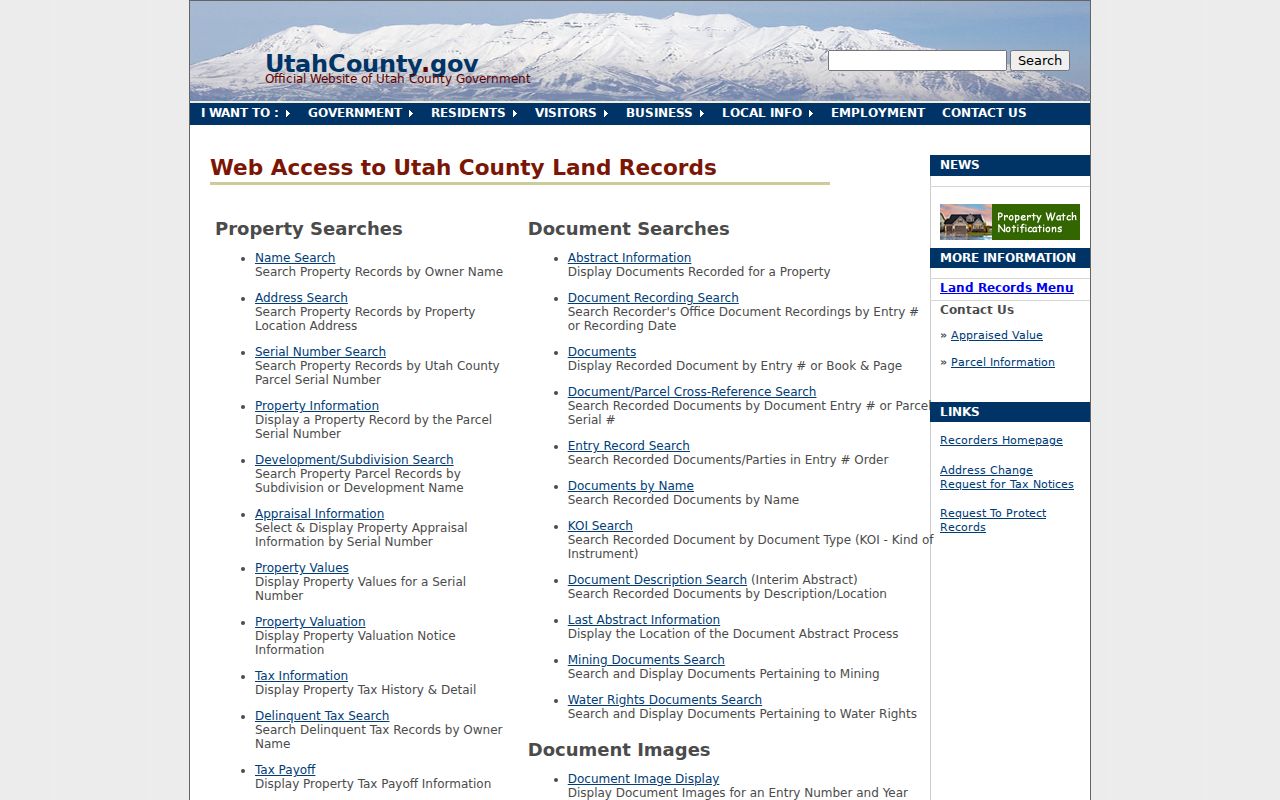
The screen matters because the first search choice should match the identifier in hand. An owner name is not a substitute for an entry number, and a current parcel serial may not represent an older parcel after a split or combination.
| Owner-search control | Input type | Use | Format or choice |
|---|---|---|---|
| Enter Name to search for | Text | Required in practice | LAST, FIRST MIDDLE; surname alone works |
| Record status | Radio choice | Required | All Records, Current Records Only, Never Valid Only |
Current-only is best for present indexed title. All Records brings older or invalid rows into view and is more useful for a title chain. The Recorder does not perform title searches, interpret documents, or supply legal descriptions by phone. Counter and mail requests remain available when the index is not enough.
Reading Springville Parcel Records
A parcel record distinguishes the physical site from the address that receives the tax bill. The county schema labels those fields as SITE_FULL_ADDRESS and OWN_FULL_ADDRESS. It can also show an indexed owner, a care-of recipient, parcel creation date, vesting document, book and page, subdivision, legal description, acreage, and tax or school district. These fields answer different questions.
Open the Utah County parcel map to inspect map and assessment context.
A tax-mailing address can point to an owner elsewhere, but it does not prove where that person lives. The site address identifies the land, not every person who occupies it. Parcel creation and serial history also matter in growing Springville areas where subdivision or annexation changes the administrative trail.
- Index
- A finding aid that points to a record; it may not be the complete document.
- Vesting document
- The recorded instrument tied to the current indexed title.
- Certified copy
- A copy authenticated by the custodian for official use.
- Custodian
- The government office responsible for keeping and responding for a record.
- Exemption
- A legal basis for withholding all or part of an otherwise requested file.
Note: Compare the owner, care-of, mailing, and site fields before drawing any link between a name and a Springville address.
Springville Public Records Custodians
Springville is not the county seat. City files begin at the Civic Center, county land offices are in Provo, and the district court serving south Utah County sits in Spanish Fork. Calling the right desk can prevent a request from being referred to another agency. It also helps the requester ask for an existing series instead of a new list that the agency does not have to create.
Utah County Recorder
100 E Center Street, Suite 1300
Provo, UT
801-851-8179
Deeds, liens, plats, and parcel title
Springville Justice Court
110 S Main Street
Springville, UT
801-489-2707
Limited-jurisdiction city cases
The Recorder handles recorded documents and ownership questions. The Assessor handles appraisal and value, while the Treasurer handles taxes and payoff. County Records Management preserves material for several departments, but it does not replace the department that created and understands the record.
Springville Court Records Boundaries
Xchange searches public district and justice case data by court scope, case number, party name, case type, birth date, citation, and filing or disposition dates. Results can show the court, case number, filing date, party and role, then link to a history. A public history may include charges, plea and disposition, judge, lawyers, proceedings, judgments, accounting, or probate roles such as decedent and heir.
Spanish Fork district data is complete after March 2, 1998. Public electronic district documents are available from July 1, 2010, though the clerk file remains authoritative. Older converted dockets can be spare, and files more than 50 years old may have moved to the Utah State Archives.
Remote guest use starts with credit and charges $0.35 per search and $1 per available document. Most district courthouses and the State Law Library provide free terminal access. Paper copies cost $0.25 per sheet. Adoption, juvenile, expunged, and sealed cases stay out of public results, while detailed documents in several family and protective-order case types remain private even when a public history or order can be seen.
Note: Narrow a common name by court, case type, and date because Xchange returns no more than 500 results.
Springville Vital Records Time Gates
Utah Code §26B-8-125 opens birth records after 100 years, death records after 50 years, and marriage, divorce, and other vital events after 75 years. A recent certificate is not open just because the requester knows a name. The subject, close family, guardian, authorized agent, or another person with a qualified interest must show identity and, when needed, proof of the relationship or authority.
Use the Utah vital certificate order choices for current certificates and abstracts.
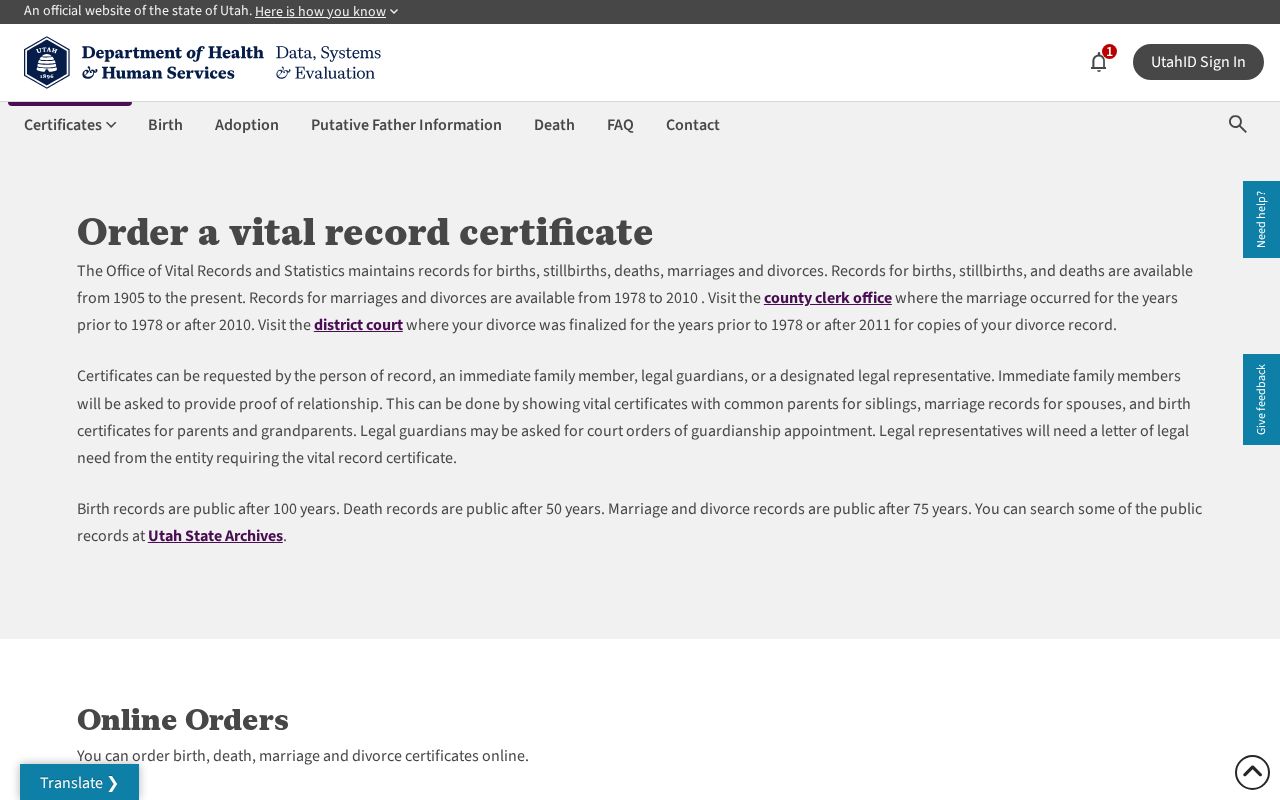
The order must identify the event, person, date and place, parents when relevant, relationship, reason, and applicant contact details. Current first-copy fees effective July 1, 2026 are $25 for birth, $35 for death, and $25 for a marriage or divorce abstract. A March 2026 birth form still shows older amounts, so the live fee schedule controls. Mail requests should allow at least six weeks.
For older family research, Utah State Archives digitized Utah County birth and death registers from 1898 through 1905 and marriage-license applications in Series 5585. An abstract from the state is not the same record as the underlying county marriage application or district divorce file.
Springville City Records Channels
City records include council action, contracts, permits, code matters, police reports, cemetery material, and local license files. Springville publishes some agendas, packets, applications, and issued-permit reports. Details such as an applicant, contractor, project cost, or older retained plan may require GRAMA. Proprietary building plans may be inspected by appointment even when copying is not allowed.
The Springville GRAMA request page is the main city entry point.
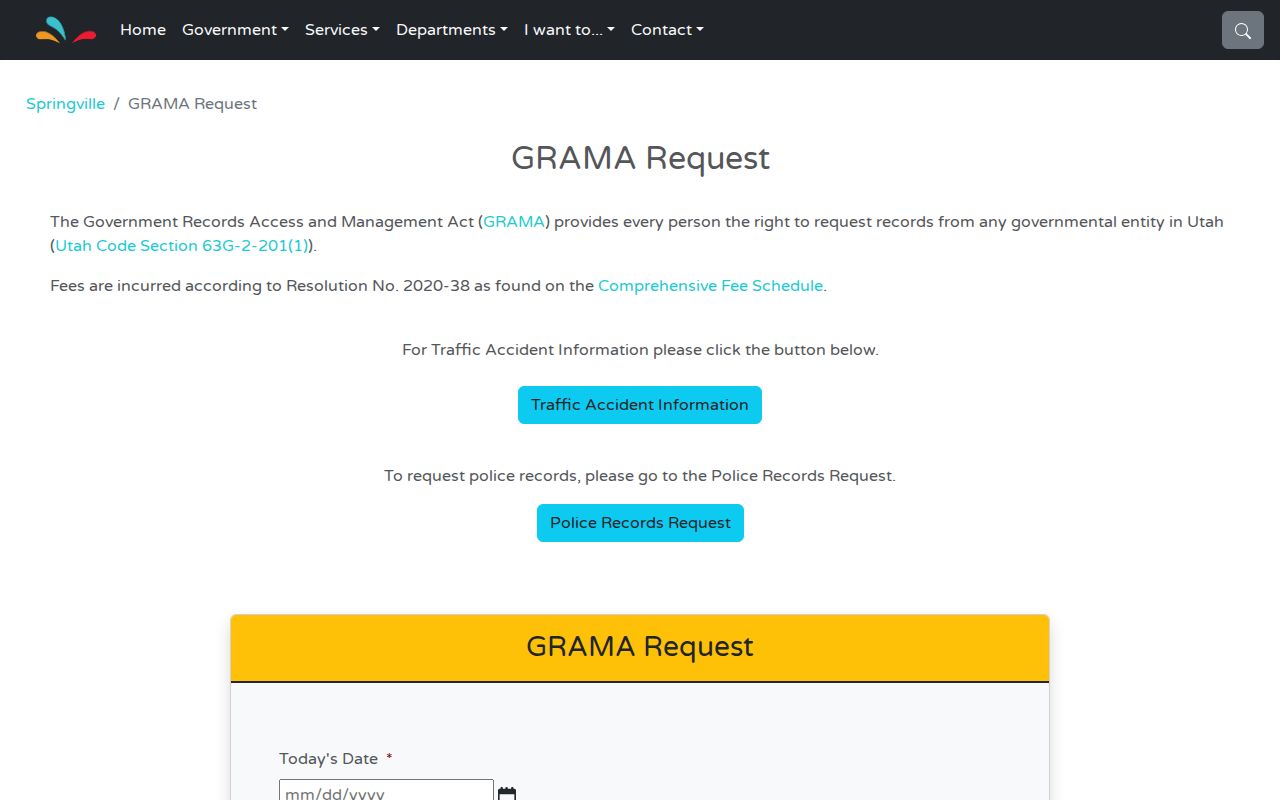
The city police form asks for requester contact details, a focused description, inspection or copy preference, maximum authorized cost, signature, and date. Police records may require identification or notarized authority for another person's nonpublic file. Community Development holds building and permit material, while Justice Court is the custodian for its judicial files.
Retention schedules can mean an older item no longer exists. Ask whether a public portion can be separated or redacted when a plan or report contains protected material.
Springville Custody Records Stay Separate
The Utah County jail search, Utah Department of Corrections search, federal prison locator, offender registry, and VINE notification service cover different stages. The county search accepts a name, arrest date, or current-inmate view and may show booking, release, agency, status, and photo after a delay. The code SV3 identifies Springville Justice Court. A booking record is not proof of a conviction.
Utah Corrections covers people under current prison, probation, or parole supervision. Federal custody is outside that tool. The state registry has its own statutory search rules and bars harassment. When an online custody result lacks the needed report, Utah County Sheriff Records takes requests for reports, crash forms, photos, and recordings through the county portal.
Note: Match the search tool to the custody stage; no result in one system says nothing conclusive about another system.
Three Cities Divide Springville Records
Local geography shapes access. Springville Civic Center holds city administration, police, permit, and justice-court files. Provo, as the Utah County seat, holds the Recorder, Assessor, Treasurer, Clerk, and central county departments. Spanish Fork hosts the Fourth District Court for general civil, felony, probate, and other district matters serving south Utah County.
That split matters when an address lies near a growth or annexation area. A postal Springville label does not by itself establish city jurisdiction. County parcel fields, legal description, map filing, and serial history can establish the land trail, while city annexation and permit material can show when municipal responsibility changed. Named canyon or subdivision roads may also need to be normalized against Springville's numbered grid before an address search succeeds.
Springville Records Costs and Counters
Free viewing and paid copies often coexist. Utah County Recorder charges $1 per recorded-document page, $5 for certification, $2 for an ownership plat, and $0.50 for a screen printout. Xchange remote searching is paid, while a courthouse terminal can be free. Court paper copies cost $0.25 per sheet, and an electronic medium or a half-day proceeding recording costs $15.
GRAMA fees must reflect approved actual cost. Staff time for compilation, programming, formatting, or manipulation cannot exceed the pay of the lowest-paid qualified worker. The first 15 minutes are ordinarily free, subject to the repeat-request exception effective March 17, 2025. Prepayment may be required when estimated cost exceeds $50 or earlier fees remain unpaid.
Inspection during normal hours is generally free. Ask for an existing digital format, narrow the date range, or request only named documents to control cost. A fee waiver may be considered when disclosure mainly benefits the public, the requester is the subject or authorized representative, or legal rights are directly involved and the requester cannot pay.
Springville Property Alerts Have Limits
Utah County Property Watch is a free courtesy alert. A subscriber searches by serial number or owner or business name, supplies an email address, and receives notice after deeds or liens affecting the parcel have been fully processed. The service may miss a relevant recording and expressly does not promise fraud prevention.
An alert can prompt a check of the actual recorded instrument. It should never replace review of the index, vesting document, or certified copy when the stakes are high. The lack of an email is not proof that no filing occurred.
Filing Springville Public Records Requests
Any person may file under GRAMA; Utah residence is not required. A request needs the requester's name, mailing address, an email address if willing, daytime phone, and a reasonably specific description. The ordinary response limit is ten business days. A request that qualifies because it primarily benefits the public has a five-business-day limit. Extraordinary circumstances can extend the time, but the agency must give notice and an estimated response date.
The Utah County records request portal handles county submissions.
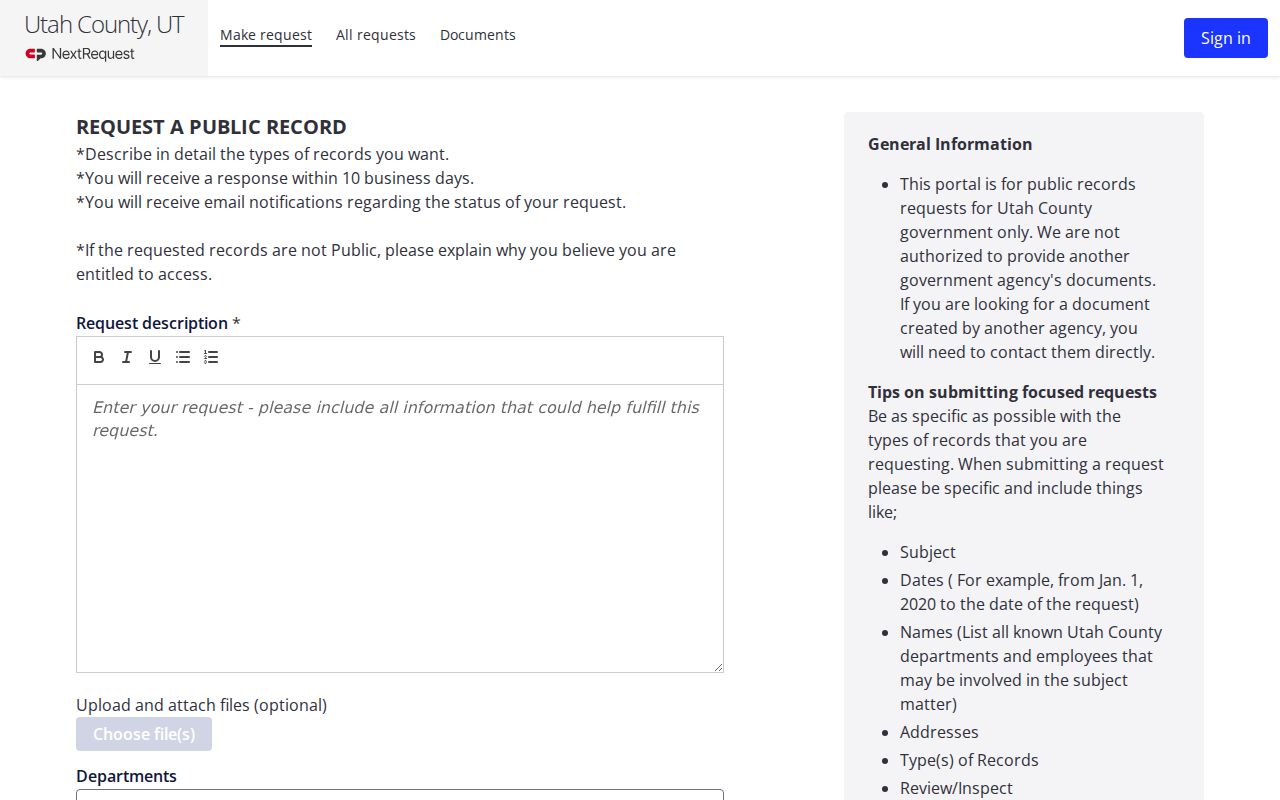
The portal provides a written trail for confirmation, routing, invoices, and responses. A request should still name the proper department and existing record as closely as possible.
- Choose the custodian. Send deeds to the Recorder, appraisal to the Assessor, taxes to the Treasurer, city permits to Community Development, and court files to the court clerk.
- Describe an existing record. Give a date range, address, parcel serial, entry, book and page, case number, report number, or named series. GRAMA does not require new analysis.
- Select inspection or copies. State the desired existing format, delivery method, and a cost ceiling. Add any valid waiver or expedited basis.
- Prove access when needed. Attach identification, relationship proof, authorization, statute, or court order for nonpublic material.
- Save the response trail. Keep confirmations, invoices, classification notices, referrals, denials, and dates in case an appeal is needed.
Lawful personal use. Open records support family research, estate work, civic review, and consumer safety. Utah law prohibits stalking and harassment, including harmful monitoring or dissemination of personal information.
Appealing Springville Records Decisions
An agency may grant access, deny access with the record classification and legal grounds, say it does not hold the record and identify a known custodian, or invoke extraordinary circumstances. A denial should also state the appeal path. Preserve the request and decision because the wording, date, and cited exemption define the next step.
A requester generally has 30 days to appeal a denial to the chief administrative officer under Utah Code §63G-2-401. Further review may proceed through the Government Records Office and committee process or district court under the applicable parts of GRAMA. A narrower request may solve a scope or cost problem, but it does not replace an appeal when the dispute concerns classification.
Ask whether the agency can release a segregated public portion. A custodian may redact protected details while providing the rest. When an online search misses an older file, also check the office terminal, State Archives series, or the creating agency before treating silence as proof that no record exists.