
Finding People Through Springville Records
Begin with the fact that is least likely to have changed. A full name can lead to an owner record, a court party, a professional license, or an archive index. An address can lead to a parcel serial, its current owner, and the deed that placed title in that name. A school year, cemetery entry, or newspaper date is often more useful for an older Springville connection than a current phone result.
Springville keeps municipal material such as permits, police reports, cemetery records, and council actions. Utah County keeps the larger deed, parcel, marriage, election, and district-court trails. State offices add licenses, business entities, vital certificates, prison supervision, and historical series. No one index covers all of them, so change sources when the known fact changes.
- Search the Utah County owner index by surname. Use Current Records for present title and All Records for past ownership.
- When an address is known, save the parcel serial and compare the site address with the separate tax-mailing address.
- Search court parties by name, then narrow common results by court, case type, and filing date.
- For a deceased relative or former classmate, move to public-age vital registers, the Springville Herald archive, yearbooks, and cemetery books.
- If the record is not online, ask the actual custodian for a named series and date span instead of requesting every record about a person.
A blank result proves very little. It can reflect a spelling variant, an older file, a private record, a changed parcel number, or a record held by another office.
Springville Search Offices
Geography decides the custodian. Springville City Recorder handles city legislative and administrative records at the Civic Center. Utah County Recorder in Provo holds deeds, liens, plats, abstracts, images, and ownership maps. The County Clerk manages elections, marriage licensing, and county records work. Court files split between Springville Justice Court and Fourth District Court in Spanish Fork. The detailed access rules belong with Springville public records, but these offices are the main routing points.
Utah County Clerk
100 E Center St., Suite 3100
Provo, UT
801-851-VOTE
Marriage and election records
Springville Owner Search Modes
Utah County does not hide property research behind one vague search box. Its free menu separates owner, address, serial, subdivision, appraisal, tax, abstract, document-name, instrument, mining, and water-right searches. That split is useful. Start with the owner tool when the name is known, but switch to All Records when the goal is a prior owner or an old family address. Current Records Only is the cleaner view of present title.
The official owner form is visible in the Utah County owner-name search.
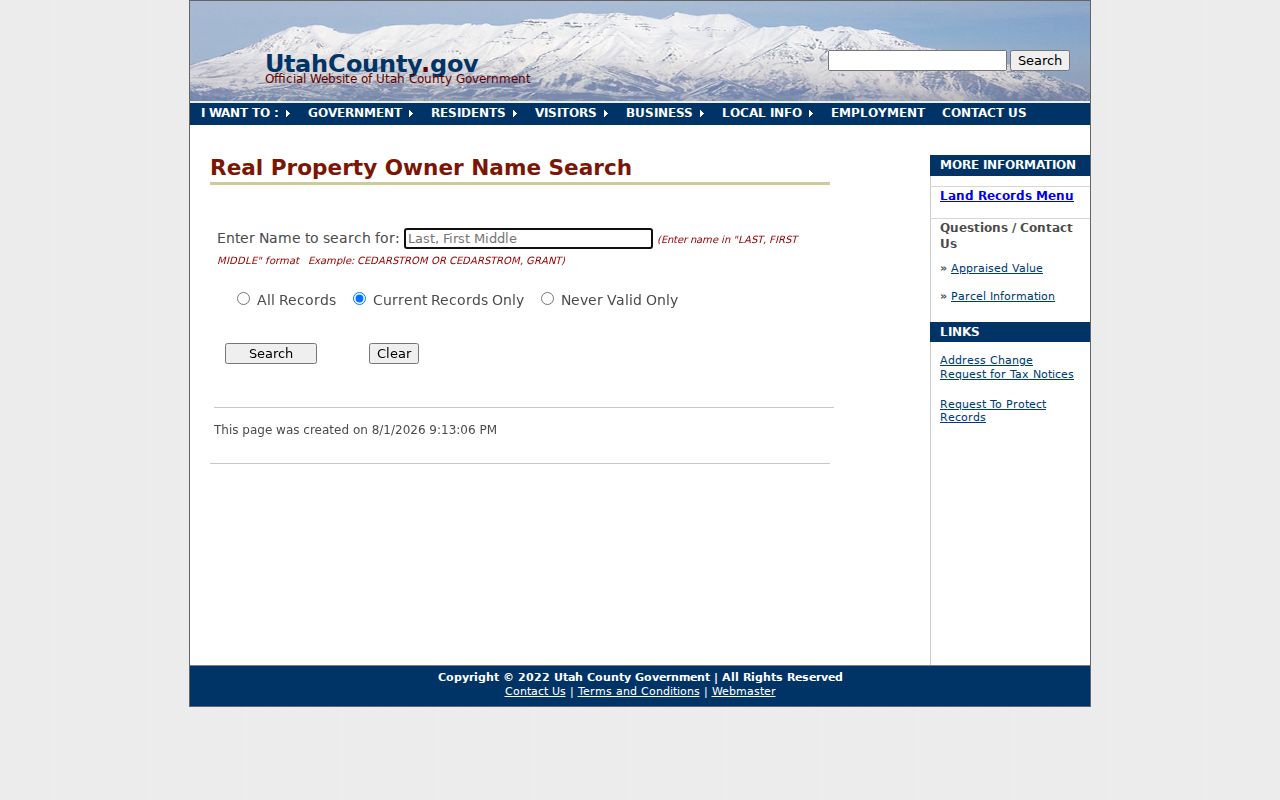
Its status choices matter as much as the text field. Use the last-name-first format, preserve middle names when available, and do not treat a tax-mailing address as proof that an owner lives at the Springville site.
| Search control | How to use it | What it answers |
|---|---|---|
| Enter Name | LAST, FIRST MIDDLE or surname | Indexed owner matches |
| Current Records | Choose present rows | Who holds title now |
| All Records | Include past and invalid rows | Earlier ownership trails |
| Never Valid | Review invalidated rows | Potential indexing history |
Springville Address Record Trail
A Springville street address can change while the land trail survives. Normalize the numbered grid or named subdivision road, search the county address tool, and retain the nine-digit parcel serial. The parcel schema keeps the physical site address apart from the owner's tax-mailing address. It can also show a care-of name, vesting document, legal description, book and page, subdivision, lot, acreage, and parcel creation date.
Follow the serial into its vesting deed, then use serial history when a tract was split or combined. The city's 2024 and 2025 annexation record is a good reminder that postal labels and municipal control can diverge. A mailing ZIP does not settle which agency held a permit or land-use file at a given date.
- Parcel serial
- The county identifier used to connect a tract with tax, map, and title data.
- Vesting document
- The recorded instrument tied to the current ownership entry.
- Situs address
- The physical site address, which differs from the owner's mailing address.
- Grantor and grantee
- The party transferring an interest and the party receiving it.
Note: Deeds establish title, not every person who occupied a Springville home.
Springville Court Search Boundaries
Springville Justice Court handles limited local matters such as class B and C misdemeanors, infractions, traffic, ordinance cases, and small claims. Fourth District Court in Spanish Fork handles felony, general civil, domestic, and probate matters. Utah Courts Xchange searches public district and justice case data statewide. Spanish Fork district coverage is complete after March 2, 1998, while older converted cases may show little detail.
The Xchange case-search entry shows the remote guest and account path.
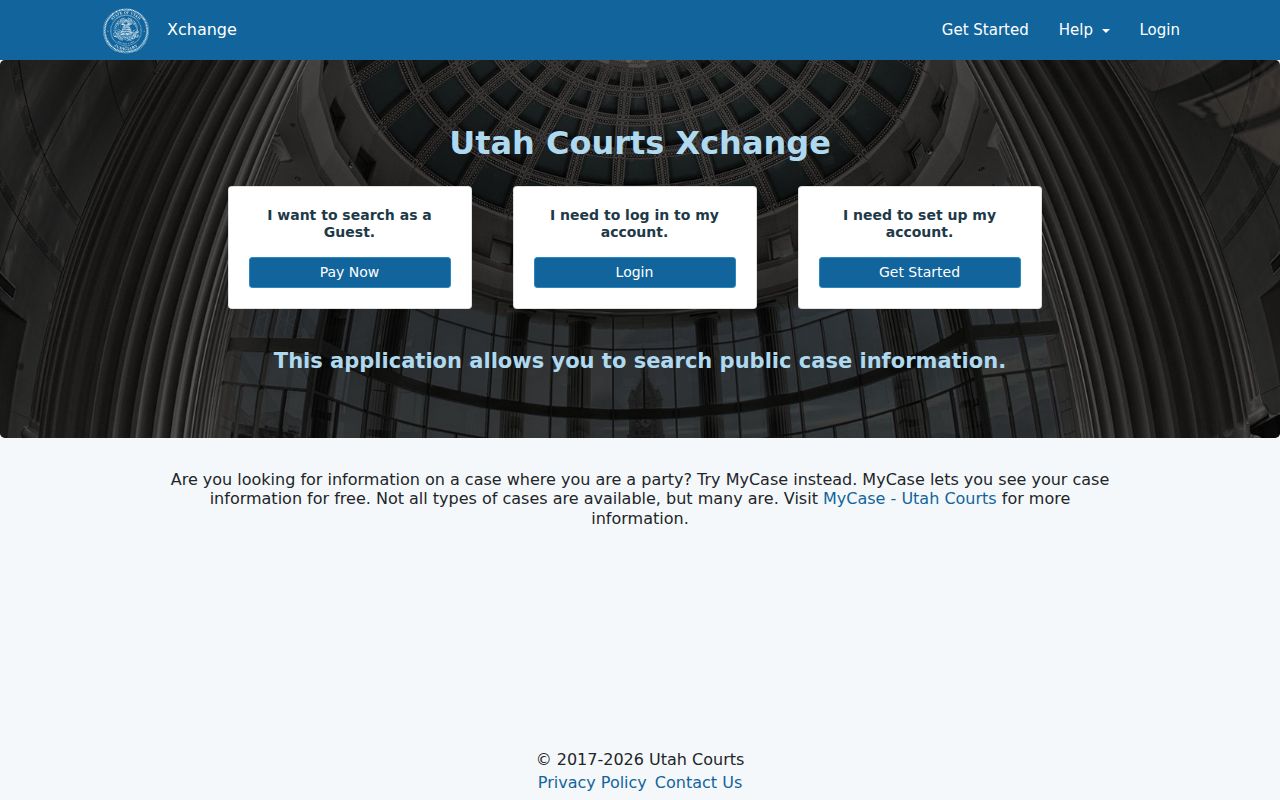
Search by surname and a first-name fragment, then narrow by Utah County, court, case type, or date. Results may show the party role, filing date, court, case number, and a public history link. Remote guest use is paid, while free Xchange access exists at most district courthouses and the State Law Library.
| Court | Covers | Name Search | Access |
|---|---|---|---|
| Fourth District Court | Civil, criminal, domestic, probate | Xchange | Paid remote or free terminal |
| Springville Justice Court | Traffic, ordinance, small claims | Xchange | Portal or court clerk |
| District of Utah | Federal civil, criminal, bankruptcy | PACER | Paid federal access |
Springville Probate Name Roles
Probate is a distinct route for a deceased Springville resident, an estate, or an heir. Xchange documents party roles that include decedent and heir, as well as petitioner, guardian, conservator, and other roles. Public case histories, judgments, orders, and letters of appointment can remain available even when detailed guardianship or similar filings are private.
Search the deceased person's name first. Then test a relative's name and narrow by probate case type, court, and date. If the electronic history is sparse, request the exact document from Fourth District Court. Files more than 50 years old may have moved to Utah State Archives, so a missing modern result should send an older estate search to the Archives rather than end it.
Springville Vital Records Windows
Utah does not make a recent certificate public just because a requester knows the subject's name. Under Utah Code §26B-8-125, birth records open after 100 years, death records after 50 years, and marriage, divorce, and other vital events after 75 years. A newer copy requires a direct, tangible, and legitimate interest, valid identification, and proof of relationship or authority when requested.
The state Office of Vital Records and Statistics issues birth and death certificates and marriage or divorce abstracts. Local health departments also issue many certificates. The Utah County Clerk keeps the underlying marriage-license material, while the district court keeps divorce case files. These are not interchangeable records.
For family history, Archives holds digitized Utah County birth and death registers for 1898 through 1905 and marriage-license applications in a separate series. Those records bridge Springville families into newspapers, cemetery books, census schedules, and church sources before statewide certificate systems became the norm.
Access limit. Use public-age indexes or prove lawful eligibility for a recent certificate. GRAMA does not override Utah's vital-record closure periods.
Springville Historical Name Search
Utah State Archives separates Name Index, Series Search, and Agency Search. The name tool accepts partial words without wildcard symbols. A result may include an image, or it may supply only enough metadata to order a copy. Search Springville, Utah County Clerk, Recorder, District Court, and cemetery as separate creating agencies. One broad query will not surface every series.
The Archives name-index gateway demonstrates the search and browse paths.
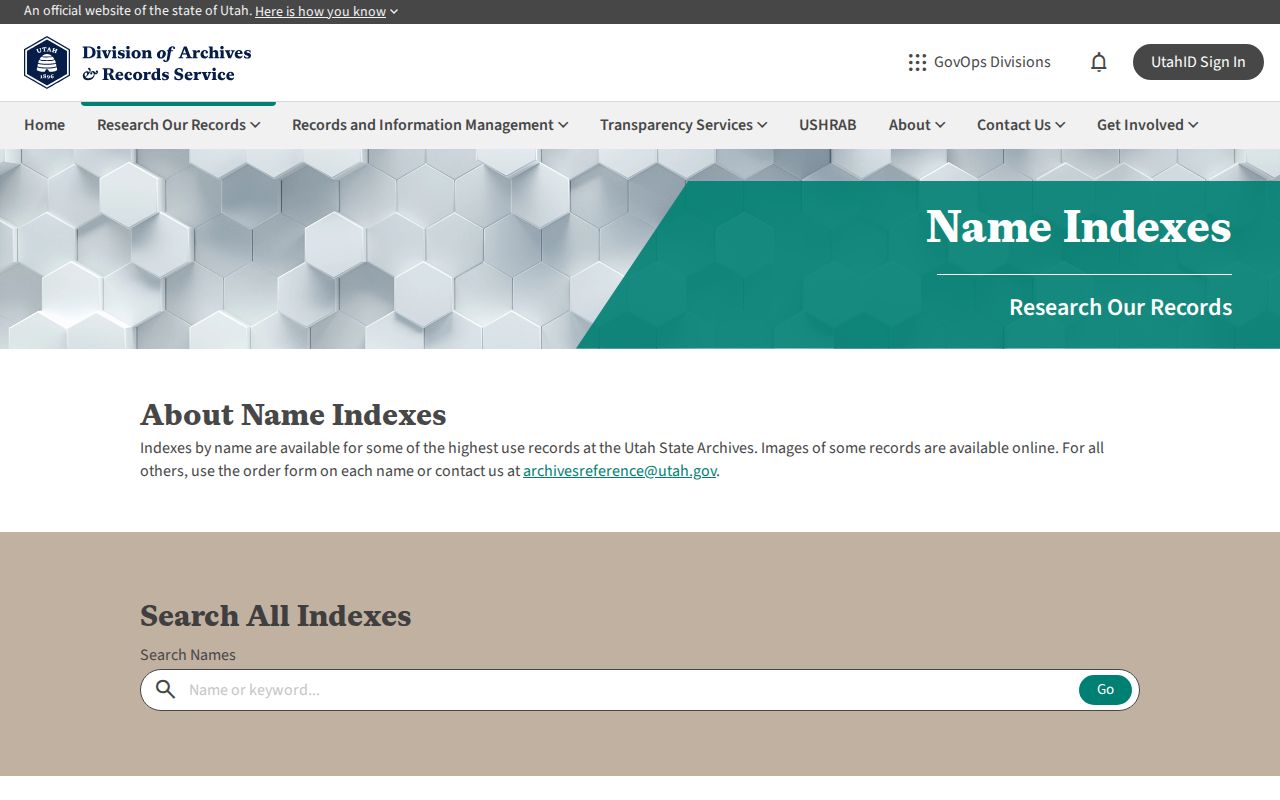
For a nineteenth-century Springville resident, add Hobble Creek, ward, pioneer, cemetery, census, and territorial terms. Public federal census schedules currently reach 1950. Save series numbers and image citations because the same name can occur in unrelated government collections.
Art City Search Story
Springville's local paper and publishing history creates an unusually strong path for families and former classmates. Searchable Springville Herald coverage runs across available issues from 1924 through 2008. Names appear in obituaries, school news, clubs, businesses, weddings, public notices, and street stories. Search married and maiden surnames, initials, and OCR-friendly fragments, then browse a known issue when text recognition fails.
Art City Publishing worked from the Herald's 1944 building and produced family histories, city books, and many school yearbooks. Surviving books may be held by the Springville Public Library, schools, the former Carnegie Library's pioneer collection, or family collections. Exact yearbook and reverse-directory holdings were not published, so ask reference staff for a title and year rather than assuming a complete run.
The Springville FamilySearch Center adds staffed help, scanners, film and audio converters, and onsite access to licensed genealogy and newspaper databases. That local access can turn a paper photograph, yearbook, or film reel into a cited digital lead.
Springville Custody Record Search
Custody records must be matched to the stage of a case. Utah County's jail search covers county bookings and current inmates, with a stated delay that can reach 24 hours. The state Department of Corrections tool covers people currently in prison, probation, or parole. Federal custody uses a separate federal locator. Utah VINE provides anonymous custody notifications by inmate name or number.
The Utah County Arrested Person Search is the correct first check for a recent local booking.
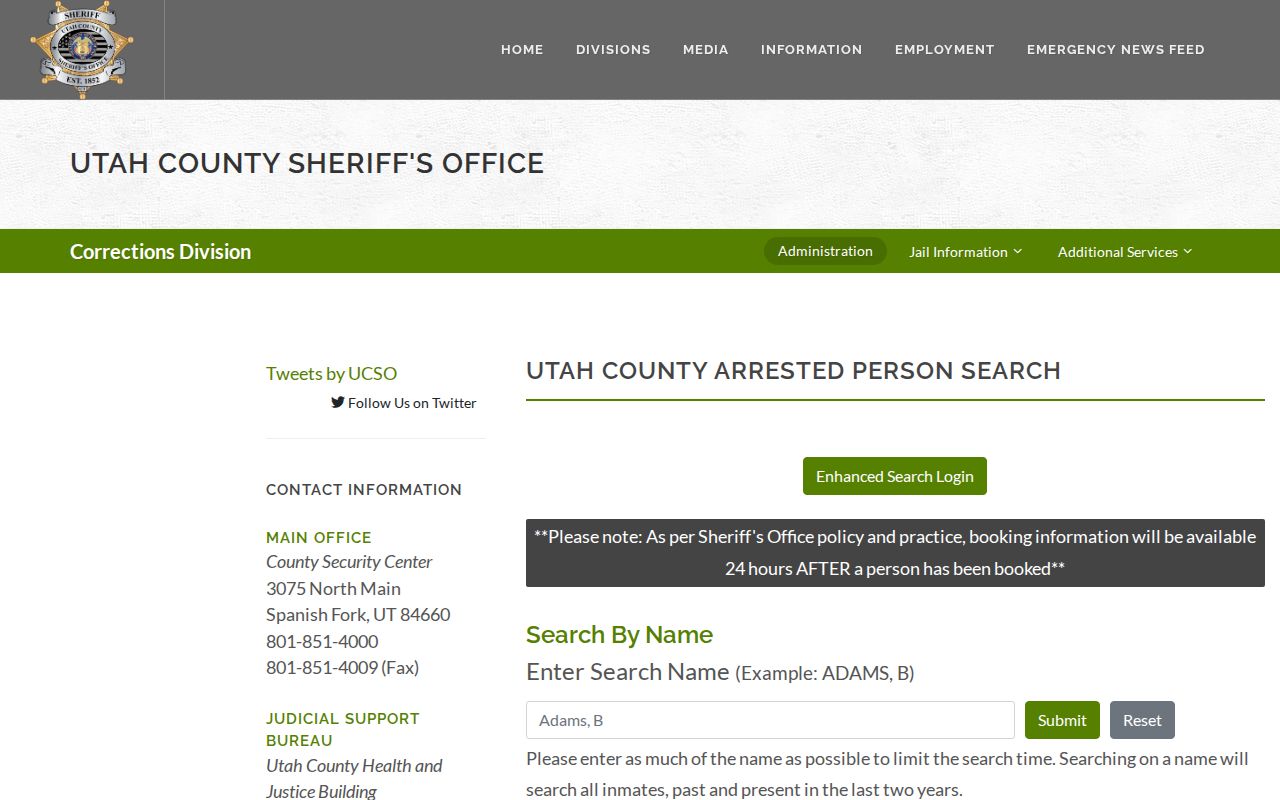
Results can include booking or release data, agency, custody status, and a photo. The code SV3 identifies Springville Justice Court. A booking is not a conviction, and a missing row may reflect the reporting delay or a move to another custody system.
Springville License Name Lookup
A trade, business, or regulated profession can distinguish two Springville residents with the same name. Utah's Division of Professional Licensing lets searchers use a license number or combine a name with a profession. The name controls include beginning-with and containing behavior. Results commonly identify the license name, number, profession or type, status, and an issue, expiration, or current-through date.
The DOPL License Lookup shows the official search choices.
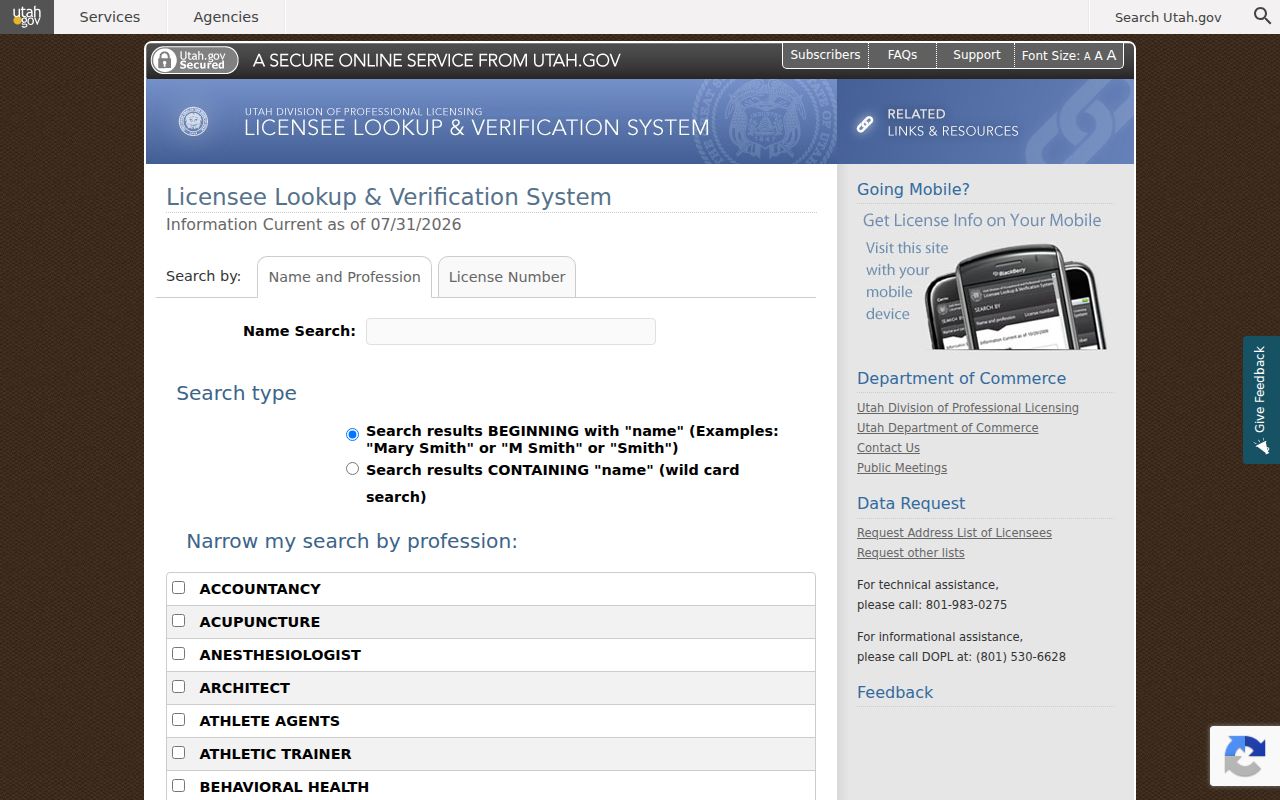
Check linked official discipline orders when they exist, since status alone is not full history. Lawyers use a separate State Bar directory. A business entity can also be checked through Utah Business Registration, but a registered agent should not be assumed to own or work at the listed Springville address.
Springville Voter Record Limits
Utah's personal voter lookup is a status, polling, and ballot-information tool. It requires a voter's name, date of birth, street address, city, and ZIP, so it is not an open surname browser. Public file categories can include name, physical and mailing address, age range, party, districts, status, and election participation. Participation never reveals ballot choices.
Full birth date, identification numbers, email, phone, and signature stay protected. Qualifying voters can seek an At-Risk designation under Utah Code §20A-2-606, which withholds personally identifying registration information. Utah County distributes governed voter reports through a request and invoice process; the complete record-set procedure is covered with Springville voter records.
Springville GRAMA Search Fallback
When a portal fails, ask for an existing record rather than a new analysis. Utah's Government Records Access and Management Act lets any person request a reasonably specific record. Give contact details, the likely custodian, the record series, a subject or address, and a date range. Choose inspection or copies, state a cost ceiling, and explain any lawful basis for access to a nonpublic item.
Ordinary responses are due as soon as reasonably possible and no later than ten business days. A qualifying request that primarily benefits the public has a five-business-day standard. An office may provide the record, deny access with reasons and appeal rights, refer the request to another known custodian, or invoke extraordinary circumstances with an estimated date.
Springville administrative records begin with the City Recorder. County department requests can use NextRequest, while court, vital, police, and land files retain their own channels. Inspection is often the lowest-cost fallback. Government does not have to create a list, summarize files, or run a custom analysis.
Verify Springville Search Matches
Springville's growth and repeated pioneer-family names make identity checks essential. Keep middle names, spouse or parent names, dates, parcel serials, case numbers, and license numbers. Search compound, hyphenated, accented, and unaccented surname forms. Compare evidence from different dates rather than merging two people because a name resembles the target.
Official records and commercial compilations serve different purposes. An official index has a named custodian and defined fields, but it may cover only one record system. A commercial compilation may be quicker and broader, yet stale addresses and merged identities are common. Confirm the useful lead with the Recorder, court clerk, archive, elections office, or licensing agency.
| Source type | Strength | Limit |
|---|---|---|
| Official current index | Named custodian and record context | May omit older or private files |
| Archive or newspaper | Historical names, dates, and relationships | Coverage and spelling may vary |
| Commercial compilation | Broad lead discovery | Can be stale or join the wrong identities |
Lawful use. Use people records for legitimate personal research. Utah law prohibits stalking, harassment, threats, and harmful misuse of personal information.